Showing posts with label Places. Show all posts

Tuesday, October 30, 2012

Prince Al's Diner


I can't even count how many times I've sat in this diner. It's one of those places that everyone in my hometown knows about and craves on a regular basis. I even remember my first time there, with my oldest brother and his friends grabbing a quick bite to eat after a rally in the park across the street. I remember feeling like I was apart of something bigger than myself.

Flash forward and I've had so many countless memories at this very place. Milkshakes with friends, meeting up with new friends for a burger, sharing poutines on dates. And yes, some memories may be fuzzier than others - try passing by 2am on a Saturday and you'll notice the line-up to get inside. It's funny how nostalgic we become to certain places. This one will forever be engrained as the place we all went to while growing up, before we became adults.

Naturally, Sebastian and I couldn't pass up the opportunity to hit up our favourite spot while we were in town. Get ready for the small town diner experience, complete with Canada's National dish, poutine. Don't judge until you try it, it truly is heaven on a plate. Draped in cheese and gravy. So probably better than heaven. Just sayin'.


Grilled chicken burrito, with a side of poutine. Heaven. On. A. Plate. I tell you.
If you ever find yourself passing through London, Ontario I highly recommend making a stop at Prince Al's Diner. I can promise you won't be disappointed.

Tuesday, August 07, 2012

The Creek


I remember the first time I went there. We walked along the trails and through the forest searching for it. We felt so close, and stopped by the creek to just stare at how beautiful it was, anxious to get where we wanted to go. As we walked along the small pathways, we heard splashing, and people yelling from a distance.

“That has to be it! It’s just over this way!”

We made our way down until the path widened. We could see the clearing up ahead. The sun was beating down on us, without a cloud in the sky, and the water was so tempting. Until at last, we made it. To Sharon’s Creek. The hidden gem tucked away in the forest.

I had lived a short car ride from the creek all my life, never knowing it existed. And upon first discovering it, my first impulse was to tell everyone about how beautiful it is. How they needed to go. And how exhilarating it is. And then my second impulse was to keep it a secret. Because when you’re there, it feels like it’s yours and nobody else’s.

Before we know it, summer will come to an end. It always seems to go by in a flash and all of a sudden, we’re spending our days reminiscing about our favourite summer memories – hanging out at the beach, the warm winds hitting your face during bike rides, campfires at the cottage, summer songs – and we knew that we wanted to remember Sharon’s Creek. And so we did. We made our way down those pathways, trying to remember how to get there. It had been nearly two years, after all. 

And when we stumbled upon that little clearing, and looked down at that water, it felt like ours all over again. We stood there for a moment, looking up at the rope that hung high up in the tree, and knew there was only one way into the water. Only one way to feel refreshed from the summer heat. I carefully made my way down to the platform, noticing how much the land had eroded with time, grabbed onto the rope as if my life depended on it. Because, let’s be honest here, it really did. I ignored the butterflies in my stomach, and swung my body into the water.

And then I did again, and again.


Friday, July 20, 2012

A Day In Gdansk


Planning our trip to Poland began over a year before we actually boarded the plane to get there. So, as you can imagine, there was a whole lot of anticipation. And build-up. And maybe even some expectations even though I told myself not to.

And the truth is, I really didn't know what to expect. And it certainly wasn't what happened.

Since this was my first time in Europe, I was expecting to be blown away by the history, the architecture, and the overall feel that you get when you're there. And oh boy, was I ever. And on the other hand...I also expected myself to be incredibly nervous - like, stuttering my words, sweaty palms kind of nervous - because I'd be meeting Sebastian's family (other than his parents and brother) for the first time ever. I mean, there was a whole lot of pressure there, not to mention a language barrier to jump over.

And let me tell you - I met some of the most warm, welcoming, and incredible people I have ever had the chance to get to know. People who I can now call family. I look back at my time in Poland and yes, the architecture was thousands of years old, things that changed the world as we know it happened there, and that feeling in the air? It's something I couldn't even begin to describe.

But what I will think about the most - is the people. Is my family. We cheered together, we danced together, we ate epic meals together, and oh yes, we drank together.

And you want to know what else we did? We went on a pirate ship together. Trust me when I say that you don't even know how excited I was. I literally turned into a pirate.

See for yourself, if you'd like...

Wednesday, July 18, 2012

The Vatican Museum & St. Peter's Basilica


Looking back at our vacation photos has been a pretty surreal experience for me. I go through an array of emotions. Remembering all the fun we had, all the incredible people I met. At times, it fills me with great joy looking back, and others, sadness that it's over. And most of all, I find myself having to pinch myself because I can't even believe that this is real life. This happened and it was the most incredible adventure.

The Vatican Museum is by far one of the most amazing sights I have ever seen. As you walk through the museum, you are surrounded by beauty and history. You can't help but be in awe and at the same time, it was incredibly overwhelming.

Sebastian and I took a three-hour walking tour of the Vatican Museum and St. Peter's Basilica, and although we had those little earpieces in listening to an abundance of information, I couldn't help but block it out and just stand there completely overwhelmed by everything that surrounded me. Some of the most famous and influential works of art can be found among the gigantic collection. Paintings so big that walls had to be destroyed just to fit them inside. Tapestry so intricately designed, you have to wonder how they possibly did it all. And then, of course, beautifully painted frescos covering the walls and ceilings. It was unbelievable. I could have spent days in there.

There's really no way that words, or even photographs could paint an accurate picture in your mind. To say it was massive, to say it was lavish.... all seems like an understatement. It was truly like nothing I have ever seen before.

Have a look at our photos, if you'd like...

Wednesday, July 11, 2012

Rome's Colosseum and The Roman Forum


Where do I even begin? The Colosseum is one of Rome's most famous buildings and enduring monuments to ancient Roman culture. It is un-freaking-believable.

A few years ago, I went on a road trip to Vancouver, B.C. It took 5 days to get there. And that was rushing through it - Canada is a massive country, to say the least. I drove back home through the U.S. and detoured just so I could see Mount Rushmore.

I was picturing something magnificent. Huge. Incredible. And after watching way too many movies, I imagined one of the mouths to open wide to reveal a secret cave. I finally drove up, parked the car, and hurried out so I could lay my eyes on the wonder that is Mount Rushmore. I felt a rush of disappointment. I thought it would be bigger. More spectacular.

The Colosseum? Nothing like that. Not even a little bit. It's bigger in real life. It's more incredible than you could ever picture it to be. Even after seeing hundreds of photographs.

On our second day in Rome, Sebastian and I took a tour of the Colosseum and The Roman Forum. Our tour guide was a funny Italian archaeologist who joked about his height, his pony tail, and assured us he wasn't gay. Even though there would be nothing wrong with it if he was. (Most Americans think he is because he carries around a messenger bag, but as he said "It's what Italians do.":) 

Have a look at our photos if you'd like! 


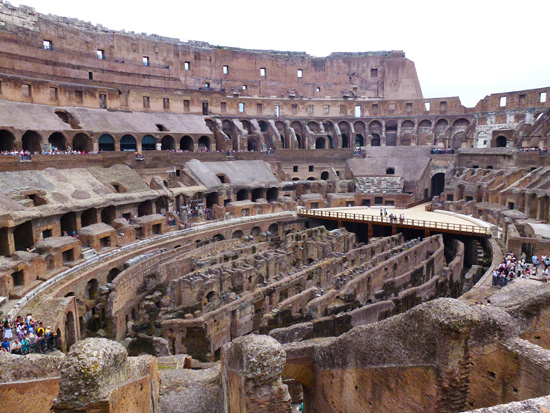
An incredible view from inside. Imagine the wood floor across the entire area, covered in sand, as it would have been originally. From this view, you can also see the underground area, where a variety of animals, such as lions or tigers, would pop-up onto the main arena from a trap door. (Archers would be ready and waiting just in case they decided to attack the Emperor.) For the Romans, it was all about the show. 

It's also unknown how many people actually died while fighting here. By the time the gladiators made it here, they were already incredibly famous and loved. In which case, people wouldn't want to see them die. Although, I'm sure some did anyway. Some of the Emperors were on a serious power trip.


Imagine this as it once was. Much like your modern day stadium. Packed with 50,000 people cheering for their favourite gladiator to win. (And for more bloodshed...)


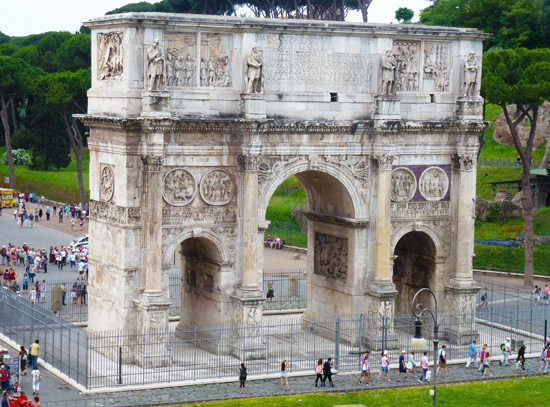
Looking out on the Arch of Constantine. (From here...)


This section of the Colosseum was rebuilt after the collapse. You can tell because they used brick to re-build it, instead of concrete.

Before the Colosseum existed, a power-hungry Emperor named Nero burned down Rome so he could steal the land for his own and then build his massive empire. Where you now see the Colosseum, used to be a giant swimming pool that was used for Nero's enjoyment. The swimming pool was then removed and the Colosseum was built for the people of Rome. The pool's removal also explains part of the reason why the Colosseum collapsed; the foundation underneath wasn't as solid. 


You can also see small holes on the outside of the Colosseum in this photo. The cause of these holes are actually from the metal clamps that held the marble in place. What you're looking at is actually the "skeleton" of the Colosseum. 

All I could keep thinking about while touring around this massive amphitheatre was... if I thought it was this amazing right now, imagine how mind blowing it would have been in its prime. Before the soft ground caused the one side to collapse. Before the metal clamps were stolen and it was stripped of its marble exterior. (Thanks, Middle Ages. Pffft.)

Now, onto the Roman Forum...


Just standing outside doors that are over 1700 years old. No big deal.


And now you know how I got that awkward sunburn that I told you about.


The Emperor's private arena. 


So much excitement!!! I whole-heartedly recommend booking a tour if you ever go to Rome and check out The Colosseum (and/or the Vatican). My head was filled with so much information during that three hour walking tour... and I know it's impossible to regurgitate it all back to you. Seeing where the chariots rode, where executions took place, how the Romans lived, and imagining what their daily lives were like... along with imagining what the insane Emperors were really like, was surreal. 
It was a day filled with nostalgia and amazement.

...And as soon as we got home, we watched "The Gladiator" to re-live it all over again. (Do yourselves a favour and watch it! It had been years since I did and I forgot just how good it is. Russell Crowe is phenomenal.) 

Can't wait to show you more! 

Tuesday, July 03, 2012

Exploring Rome


As we boarded the plane to head to Rome, I was filled with excitement. (Which also could have been from the adrenaline that was pumping through me after being sent back through security right when we were about to board our plane, then having to go back through it all again in hopes that it didn't leave without us. But that's a whole other story...)

I didn't really know what to expect when we landed, but the anticipation was killing me. We arrived late at night, and shuttled into downtown by bus, and were greeted by the hustle and bustle of the city.

We tried to quickly orient ourselves with our surroundings with the help of a map, and with no help from the locals, who so eagerly told us to go in the complete wrong direction. Luckily, I - and by I, I mean Sebastian, can tell when people are bullshitting us and we found some nice policemen to help instead. (Be warned, fellow travellers!)

Even though we arrived late at night, we were eager to see the city. We wined and dined, and explored as much as we could.

The only way I could possibly explain how I felt about our experience in Rome is that... I was in awe of its beauty, and I was completely fascinated with its history. There is so much to do and see, and you will most definitely need a new pair of feet by the end of it.

But it's totally worth it.

(I apologize in advance for the length of this post, and the amount of photos used. But c'mon! Cut me some slack. It's incredibly difficult to choose a select few from the hundreds taken. Soooo I did pretty good:)


Tuesday, May 29, 2012

Exploring the City


Over the weekend, Sebastian and I decided to take advantage of the gorgeous weather, hop on our bikes, and explore the city! We didn’t have a plan in mind, just peddled off and went wherever we happened to end up.
While biking east on Lakeshore, we came across the new waterfront park. Toronto has had plans to redevelop the waterfront for a while now, since it looked horrible and industrialized. I had no idea that they already completed some of it! It was such a wonderful surprise. I’m so excited to see the rest of it when it’s all done! Being near the water is such a luxury and it’s pretty sad that it’s not being utilized the way it should be right now.
We admired the pretty tiny waterfalls, the new splash pad, and splashed around in the cold water.

… Then went on to take photos of our footprints. Because apparently, we’re cute like that.

We biked around some more and ended up in St. James Park. I actually had never been to before, which kind of seems ridiculous since I’ve been living in the city for over a year now. (I’ve officially decided that we’re coming back here for a picnic just because it’s so beautiful.)
One thing that I’ve truly come to love about living here is that there are so many hidden gems everywhere. That awesome burrito place, that hole-in-the-wall café that makes their own lemonade, and the parks that make you feel like you’ve left the city even though you’re smack in the middle of it.

…Then we found this tree branch that was perfectly parallel with the ground! It looked so crazy that I instantly wanted to climb it.
…Then I came to the realization that a) I am incredibly short and b) I am far too weak. Unlike Sebastian, who is a giant in comparison.

The AGO (Art Gallery of Ontario) currently has a Picasso Exhibit running until sometime in August, and I’ve been wanting to see it ever since it first started – so when Sebastian suggested we go there, I pounced on the idea! (We did the audio tour, and I snuck this picture of Sebastian without him knowing:)

“I paint the way some people write an autobiography. The paintings, finished or not, are the pages from my diary.”—Pablo Picasso

We saw paintings like this 1925’s Le Baiser, or The Kiss, from his Surrealist period.

And this moving piece, entitled “Massacre in Korea”, which is seen as a criticism of American intervention in the Korean War, and was influenced by Goya’s, The Third of May 1808.

I think what I was most surprised with was how Picasso could so easily go back and forth between different styles of art. From expressionism to cubism to realism, experimenting with different ideas and techniques, switching between different mediums - paintings to sculptures to a combination of both. He was a true genius, and he knew it.


If you ever get the opportunity to come to Toronto, I definitely recommend hitting up the AGO! The museum itself is a work of art and worth exploring.
I can’t wait for the rest of the summer where we can explore even more of the city and discover all sorts of new things.

Wednesday, February 15, 2012

Ik Kil Cenote, Mexico


Last week, I reminisced about my vacation to Mexico and let you in on the fascinating information that I had the pleasure of learning while visiting the Chichen Itza site. I touched on everything from Mayan architecture to human sacrifice to how the Mayans used astronomy in their daily lives.

But the most beautiful, breathtaking site we went to that day wasn't man-made at all.

For those of you who don't know (and I didn't), a cenote (pronounced se-no-teh) is essentially a natural sinkhole that is most common in Mexico and Central America. It forms when limestone collapses, revealing the water underneath.

This particular cenote is called the Sacred Blue Well, or Ik Kil, and it is said that this is where the Kings and their courts enjoyed contact with nature, for meditation and rest.
The cenote itself is perfectly round, at around 200 feet in diameter, is 130 feet deep, and is actually located 85 feet below ground level. A grand stairway made of limestone, slowly leads you down to the pristine, crystal clear water.

I made my way down the staircase, making deliberate moves while clutching onto the chains at the side for fear of slipping down the limestone steps that were covered in a trail of wet footprints.
When I reached the bottom, all I could do was look up at the sky, the warm sun shining down illuminating my surroundings. I studied the cenote in awe, sure that this type of thing only existed in paintings and stories. My eyes followed the long trails of vines that hung from the opening leading all the way down to the water, accompanied by small waterfalls. It was too beautiful to even be real.
What else could I do? I launched my body into the water. It was warmer than I had expected but still cold. It was hot that day, with the sun beating down on us, and after a long morning looking at Mayan ruins, it was a burst of refreshment that I needed.
I floated on my back in the water, making sure to take in everything, not forgetting the details, which over time, can become blurred memories of something wonderful. I let the water incase me while surrounded by vines and the sounds of running waterfalls.

I would go back again just to see that.

Thursday, February 09, 2012

Chichen Itza, Mexico: The Observatory


Yesterday, I told you a bit about the Chichen Itza site, and all about El Castillo, The Great Ballcourt, The Wall of Skulls, The High Priests' Temple, and touched on some Mayan mythology. But today it's all about one of the most interesting (and coolest) structures at Chichen Itza - The Observatory also known as El Caracol, which means "The Snail". It gets its name from the stone spiral staircase inside.

"This structure is a circular astronomical observatory built on a large square platform. The spiral staircase inside the building leads to the top observatory chamber designed with windows for astronomical observations. (We were also told there's carvings on the walls and roof showing the constellations, but unfortunately, this site is no longer open to the public) From those windows, Mayan astronomers noted the positions of the Sun, the Moon’s greatest northern and southern declinations, and the passages of Venus. They used the shadows inside the room cast from the angle of the Sun hitting the doorway, for example, to tell when the solstices would occur.

The Maya regarded everything as closely related to their notion of time. For them, the need to record and to determine certain events in time, as well as the need to foresee the regular occurrence of astronomical, religious and social events, resulted in the invention of one of the most accurate calendars in history. The Maya calendar is considered the most complex, intricate and accurate among ancient calendars. Some claim that the calculations of the congruence of the 260-day and the 365-day Maya cycles are almost exactly equal to the actual measured solar year in the tropics, with only a 19-minute margin of error.

A "clock" can be anything we can use to measure time. The Maya used light and shadow cast in edifices, zenotes, and other bodies to track time. At the tropical latitudes of the Mayan cities, for example, the sun passes directly over head twice per year. Very accurate timing could be achieved by determining just when this happened - sort of like setting your watch. The Maya sought to understand the repetitive cycles of motions of the moon and planets, and thus to be able to predict when these bodies would be in certain places on the sky in the future. The planet Venus was very important and the tabulation of the appearances of Venus was used to predict the future.

For the Maya, the sky, their calendars, and mythology were integrated into a single system of belief. The patterns of the stars in the Milky Way or constellations, were directly related to their vision of Creation. The Maya called the Milky Way galaxy World Tree, which was represented by a tall tree, the Ceiba, reaching up to where all life came from.

The Maya also referred to the Milky Way as the Wakah Chan, which means “White Boned Serpent.” They believed to be connected to the cosmos. In fact, Kuxan Suum is a Mayan concept that means literally the “path in the sky to the center of the universe.”

There is also evidence to suggest the Maya were the only pre-telescopic civilization to demonstrate knowledge of the Orion Nebula. What supports this theory is a Mayan legend related to the Orion constellation they called Xibalba. They referred to the nebula as smoke from burning copal incense. Scholars believe this is significant, and it gives credence to the idea that the Maya detected a diffuse area of the sky before the telescope was invented.

There is no astronomy without mathematics. And the Maya astronomy was no exception. Mayan mathematics is the most sophisticated mathematical system ever developed in the Pre-Columbian Americas. The ancient Mayas discovered two fundamental ideas in mathematics: place notation and zero. That the Mayas understood the concept and value of zero is extraordinary and astonishing, for at that time most of the world’s civilizations had no concept of zero." (Source)

Isn't that so incredible? The trip to Chichen Itza will be one that I will never forget, and if you ever get the chance, trust me and jump at it.

Wednesday, February 08, 2012

Chichen Itza, Mexico


Last year, I went on vacation to the Mayan Riviera, Mexico for a friend's wedding and had the wonderful opportunity to visit Chichen Itza, one of the new Seven Wonders of the World.
Believe me when I say, this was such an amazing, fascinating experience. Not only are you seeing these incredible structures that were built around 600 AD but you are learning about Mayan civilization; their daily life and culture.
Chichen Itza was built by The Maya who were an ancient civilization of southern Mexico and the Central American countries of Guatemala, Honduras Belize and El Salvador. Today there are an estimated 6 million Maya living in these regions and speaking a variety of Maya languages.
This site has mystified thousands of people for hundreds of years and what fascinated me most was how advanced the Mayans were. Every detail of what they built was thought out and extremely well-planned, and they based their daily life off of astrology and were extraordinarily good astronomers themselves.


El Castillo, is a square-based, stepped pyramid that is approximately 75 feet tall that was constructed around 1000-1200 AD. There are 91 steps on each of the four sides, leading to the throne room at the top making a total of 365. (Which is, as you know, the number of days in a year). The stairways divide the nine terraces of each side of the pyramid into eighteen segments, representing the eighteen months of the Mayan calendar.
One of the most fascinating features of this pyramid happens twice a year, during the Spring and Autumn equinox. The sun is in exactly the correct position to cast a shadow which resembles a snake descending to the ground. (This would happen in the left side of the pyramid shown in the first photo) It is said that this was constructed this way in connection to agricultural rituals.
Unfortunately, because of vandalism to the pyramid over time, people are no longer allowed to climb or go inside in order to preserve it's beauty.


El Castillo was actually built on top of another temple, which wasn't discovered until the 1930's. After several false starts, they discovered a staircase under the north side of the pyramid. By digging from the top, they found another temple buried below the current one. You can see the excavations in this photo, which began in 2006.
From this photo, you can also see on the left side that the entire pyramid has not been restored. A local hotel actually came to the site long ago and stole pieces of the pyramid before the restoration began and used it to build parts of their hotel. Since archaeologists will not replicate any of the structure, unless these pieces are given back, El Castillo will never be fully restored. Locals are currently petitioning against the hotel. 


This is the Great Ballcourt of Chichen Itza, where a ball game would be played consisting of two teams. It has no vault, no discontinuity between the walls and is totally open to the blue sky. A whisper from end can be heard clearly enough at the other end 500 feet far away and through the length and breath of the court.
The sound waves are unaffected by wind direction or time of day and also night. Archaeologists engaged in the reconstruction noted that the sound transmission became more and more strong and clear as they proceeded.
In 1931 Leopold Stokowski spent 4 days at this site to determine the acoustic principals that could be applied to theater for an open-air concert he was designing. Stokowski failed to learn the secret. Today it has not been explained.


The object of the game was to get the ball through the stone hoop. This was extremely difficult, so if it actually happened the game would be over. Points could also be scored by tossing the balls so that it touched the ring. Players of the game couldn't hold or touch the ring. Other basic rules were applied to the game as well, the ball could not touch the ground and players couldn't hold or touch the ball with their hands - only the elbows, knees, hips, and head were used. The players were very skillful, and the ball could stay in the air for an hour or more.
The player who won the game by getting the ball through the stone hoop, was then declared the winner, and in return would be decapitated. Legends have also said that it is the winning Captain who would present his head. Of course, for us, it seems strange to fight to win just to die but for the Mayans it was considered the ultimate honour, and would lead to heaven.


On either side of the ballcourt, royalty would sit to observe the games.


Here's a closer look at the structure that the Mayan Kings and family would sit at, you can still see hints of the colour that was used even back then that hasn't completely vanished over time. You can also see the elaborate carvings that were etched into the stone. These types of carvings were seen throughout the entire stretch of the ballcourt, often depicting images of warriors.


This is the Wall of Skulls, or the Tzompantli, where the heads of the sacrificed were placed as a sort of shrine to the game. You can make out the carvings of each individual skull in the stone.


These two pictures are interesting because you see in the first photo, that the structure, which is called The High Priests' Temple (although it isn't believed that this was a tomb or that priests were buried here) has been restored. And in the second photo, our tour guide is pointing out what it would've looked like when it was first discovered. This, in actual fact, was a painting, since colour film didn't exist back then.
Another interesting fact, in some religions, the serpent or snake represents evil or the devil but in Mayan mythology, the serpent actually represents rebirth.

Did I mention that we saw of ton of these little guys? Seriously. Everywhere.

P.S. Stay tuned for tomorrow's post about my favourite structure that we saw at the Chichen Itza site!

AddThis